
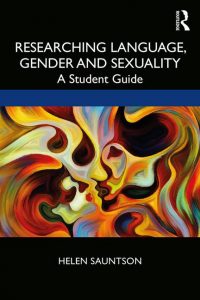
 This module is designed to give you a thorough grounding in the main areas of feminist and queer linguistic enquiry. Language, gender and sexuality is a diverse and often controversial field, which gives rise to varying and sometimes contradictory theories and methods of analysis. You will learn about a range of theoretical and methodological approaches to the study of language, gender and sexuality. And you will learn about how some of these approaches have been applied in domains such as education, the workplace, legal contexts, literature and the media. The main aim of the module is that, after you have been presented with some of these theories, approaches and applications, you will be able to take up and argue for your own, informed position and use the grounding they have received as a starting point for your own work and ideas. You will have an opportunity to collect and analyse your own linguistic data throughout the module and in the final written assignment.
I wrote Researching Language, Gender and Sexuality: A Student Guide (Routledge, 2020) to guide you through this module and to teach you how to conduct your own research in this area of linguistics. It is a widely acclaimed textbook which is already being used on Language, Gender and Sexuality undergraduate modules across the country. But only you will have direct access to the author!
A number of my other publications are used on this module. Language, Sexuality and Education (Cambridge University Press, 2018), Schools as Queer Transformative Spaces (Routledge, 2019) and Approaches to Gender and Spoken Classroom Discourse (Palgrave, 2012) all inform the work we do on examining language, gender and sexuality in classrooms and other educational settings. You will find Gender and Language Research Methodologies (Palgrave, 2008) useful for introducing you to a range of theories and analytical approaches commonly used in the field. New Perspectives on Language and Sexuality Identity (Palgrave, 2008) is used when we learn about LGBT+ identities and language in contexts such as coming out and conversational interaction.
Helen Sauntson
You can find my official university webpage here , and you can follow my Amazon author page here.